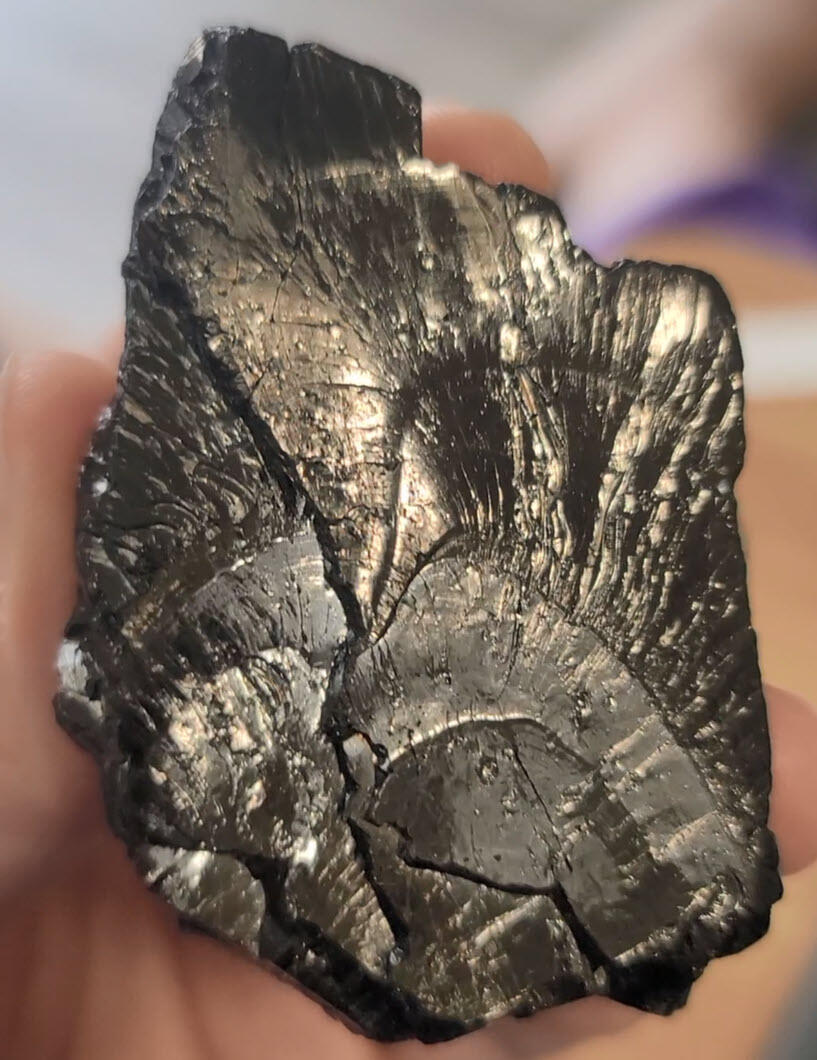
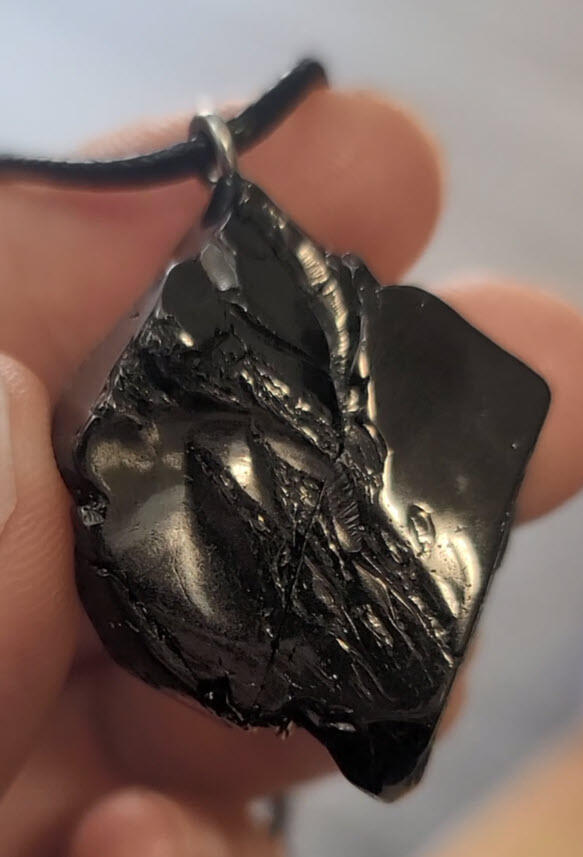
How to Tell Real Shungite from Fake — The Shungite Medium, Chapter 14
The Stone and the Evidence · Complete chapter · from The Shungite Medium by Gary Fong

I went to Amazon, looking for shungite that would ship in two days instead of five months. I found a listing for a "Raw, Type 1 Shungite" pendant. It arrived. I held it up to a window. It was the wrong weight, too dense, no porosity. It had no pull to it. It felt inert.
I am not normally a person who reaches for a hammer to settle a question. I did that day. Real shungite, being a rock, should shatter under a sharp blow. This piece broke neatly in half, revealing black plastic inside.

I had been sold a chunk of dyed acrylic by a top-rated Amazon seller with hundreds of five-star reviews. That was the moment I understood
that what I had stumbled into was not just a personal health discovery. It was a market that was almost entirely fake.
The third category of fakes is the one I have the most direct experience with, because it is the one that affects my own business: counterfeit shungite itself.
By my own field estimate, roughly eighty to ninety percent of the stone sold worldwide as "shungite" is either outright fake, mislabeled, or so degraded that it does not perform the way authentic shungite performs. [1] When someone tells me "I tried shungite and it did nothing," the most likely explanation is that what they held in their hand was not shungite.

The Conductivity Test
Authentic shungite, particularly Elite Type 1, with its carbon content around ninety-seven percent, conducts electricity. This is its defining physical property and the property most fakes cannot fake.
The test takes about ten seconds with an inexpensive multimeter. Set the meter to resistance. Touch one probe to one face of the stone and the other probe to the opposite face. A genuine Elite Type 1 stone reads a low resistance value, electrons are flowing through the carbon lattice. A fake reads "1" or "OL", open loop, no current, no conductivity. The stone is an insulator. It is some other rock, or polymer, or pressed material entirely.
Some sellers spray fakes with graphite powder to fake conductivity on a quick test. The coating wears off within a few uses, and a careful probe through to the interior of the stone will read open loop again. If a stone conducts on its first reading but stops conducting on its third or fourth, it is graphite-coated.
Two Tests That Don't Work
There are videos circulating online, many of them with millions of views, in which a supposed expert rubs a piece of shungite on white paper. If the stone leaves a black streak, the video says, it is real. If it does not, it is fake.
This test is not what it claims to be.
Raw, untreated shungite that has not been cleaned will leave a black streak because it carries loose carbon dust on its surface.
So does a pencil.
Pencil lead is graphite, a form of carbon, and rubbing it on white paper produces exactly the same black mark. The streak test cannot distinguish authentic shungite from a Number Two pencil.
More importantly: every Elite Type 1 stone I sell has been ultrasonically cleaned, a process that removes surface dust and oils without affecting the stone's interior carbon structure. Properly cleaned authentic shungite often leaves no streak. By the logic of the streak-test videos, my real Elite Type 1 stones would fail their test, and a Number Two pencil would pass it.
A second test making the rounds is the flashlight test. Here is how it actually works. You take a cheap pocket flashlight, unscrew the cap, and place a small piece of shungite between the battery contacts and the flashlight body, using the stone to complete the electrical circuit. If the bulb lights up, the video says, you have real shungite.
This one is closer to the right idea than the streak test, and that is the problem.
The flashlight test is, at bottom, a crude conductivity check. Real shungite IS conductive, that part is true. But so is almost everything else that is dark and metallic-looking. Graphite lights the bulb. Hematite lights it. Magnetite, pyrite, anthracite coal, all of them light the bulb. A polished gold watch will light it. Counterfeit "shungite" from a budget online marketplace, often made of pressed graphite or graphite-coated rock, lights it.
The flashlight test produces a true positive on real shungite. It also produces a true positive on many substances that are not shungite. It cannot tell the difference. As a single test for authenticity, it is no better than the streak test, it just looks more scientific because there is a battery in it.
The correct version of the same idea is a calibrated multimeter. Touch its probes to opposite faces of a genuine Elite Type 1 stone and the resistance reading drops to zero. Electrons flow freely through the carbon lattice. Pressed-graphite imitations show partial conductivity but rarely a clean zero. Coated rocks fail entirely once the probes break through the coating.
For water-related uses, there is a second valid test. Drop the stone into a glass of water, let it sit for fifteen minutes, and read the result with an oxidation-reduction-potential meter, an ORP meter, available for under fifty dollars. Authentic shungite produces a measurable antioxidant shift in the water within that window. Fakes do not.

These two tests work because they measure properties shungite actually has: molecular conductivity, and antioxidant interaction with water. The flashlight test, the streak test, and most of the other consumer tests you will find online measure properties that do not isolate shungite from anything else dark and carbon-adjacent.
While we are at the ORP meter, a related note on a competing claim. There are commercially available hydrogen-water converters that advertise ORP readings as low as minus seven hundred millivolts. Those readings are real in the sense that the device produces them. They are misleading in the sense that no natural water source on Earth, not springs, not glacial melt, nothing the body evolved to drink, sits anywhere near that value. Shungite-treated water sits in the antioxidant range natural mineral springs actually sit in, which is the range the body knows what to do with. Pushing past that into territory chemistry does not produce in the wild is not necessarily an improvement.
One more consumer-side flag worth knowing: price. Authentic Elite Type 1 currently costs roughly ten U.S. dollars per gram at the mine. If a seller offers large chunks of "Elite" for under twenty dollars total, you are not looking at Elite. If the listing says "Colombian Shungite", or shungite from anywhere outside Karelia, Russia, you are not looking at shungite at all. (More on that variant in a moment.)

What the Fakes Are
The fakes I have personally tested and identified fall into a small number of categories.
The most common is mislabeled lower-grade material. Type 2 and Type 3 shungite are real minerals with real carbon content, but at much lower percentages, Type 2 sits around fifty to seventy percent carbon; Type 3, around thirty to fifty.[2] Both are legitimate stones with legitimate uses, including filtering water. Neither performs the way Elite Type 1 performs, and neither contains the high fullerene fraction that distinguishes Elite material. When sellers label Type 2 or Type 3 stones as "Elite," they are charging Elite prices for Type 2 product. This is the single most common counterfeit pattern.
The second category is unrelated black minerals, anthraxolite, jet, polished obsidian, and a Colombian carbon mineral called Raquirite, sold as shungite. None of these have shungite's carbon structure or conductivity.[3] Two of them, Raquirite and jet, deserve a closer look.
Jet.
Jet is the more visually convincing imposter, and the older one. Jet is lignite, the lowest rank of coal, formed when ancient wood, often from conifer species in the Araucariaceae family, was buried under sediment and compressed over tens of millions of years. The most famous source is Whitby, on the Yorkshire coast of England, where jet has been mined since the Bronze Age and worked into jewelry, mourning ornaments, and ceremonial objects. The Whitby deposits date to the Jurassic period, roughly one hundred and eighty million years ago.[4]
Jet looks like shungite. Both are deeply black, opaque, carbon-rich, and capable of being polished to a mirror finish. To a buyer holding a polished pendant up to the light, they are visually indistinguishable.
But on the multimeter they are opposites.
Jet is an electrical insulator. Its carbon is bound in long hydrocarbon chains inherited from the original woody material, chemistry built for organic structure, not electron transport. Touch a multimeter probe to opposite faces of a piece of jet and the meter shows open loop. No current. No conductivity. Genuine shungite, by contrast, reads near-
zero resistance, electrons flow freely through the fullerene-bearing carbon lattice. The two materials, despite looking identical, sit at opposite ends of the conductivity spectrum.
Anyone selling a jet pendant as a shungite pendant is selling a piece of pretty fossilized wood as a piece of conductive Karelian carbon. The wood is real. The shungite is not.
The third is industrial: polymer or pressed-graphite imitations manufactured in bulk, polished to look like real stone, sometimes with embedded metal flakes for weight. These show up most often in jewelry, pendants and beads, where the customer is unlikely to break the piece open to inspect it.
If a stone marketed as "Elite Shungite" looks like a perfectly polished sculpture, weighs less than a comparable piece of granite, or is priced like ordinary quartz, it is almost certainly not Elite. Authentic Elite Type 1 is fragile, layered, inconsistent in appearance, and rare enough that only an estimated two to three hundred kilograms is mined per year worldwide.[5]
Deep Mine versus Elite Type 1
Within the small remaining pool of authentic Elite Type 1, there is a further distinction worth understanding: where in the deposit the stone came from. Surface-mined and shallow Elite Type 1 has been weathered by exposure to air, moisture, and surface oxidation over geological time. Deep Mine Type 1, extracted from below the weathering zone, preserves the highest fullerene fraction and the purest carbon structure. This is the distinction that matters most to anyone using shungite for its actual properties, rather than as a decorative object.


Shungite is occasionally suspected of being radioactive, a question that comes up from people who have heard the stone may have come from a meteor and assume any rock with an exotic origin must be hot. It is not.
A Geiger counter is the standard scientific instrument for detecting nuclear radiation. I tested several pieces of shungite with one. The reading against a standard cell plate was zero. The reading against a thicker, denser cell plate was zero. The reading against the largest piece in my own collection, a massive rock from the Karelian seam, was zero.
Shungite does not emit measurable nuclear radiation under any of these conditions. The rock is two billion years old, it formed from carbon, and it carries none of the heavy isotopes that produce ionizing radiation. If it did, the mine would not be worked by hand.
Scan to watch the Geiger counter test.
Certification Of Authenticity
After the pyramids that do nothing, the stickers with claimed perimeters that violate physics, the streak tests and flashlight tests that can't tell the difference between shungite and a pencil, a frightened customer asks the obvious question first. How is anyone supposed to know what is real?
There was no honest answer when I started looking. I built this because nobody else was. The woman on the rooftop. The Lifetune sticker I put on my own meter and watched do nothing. The streak-test videos with millions of views training people to authenticate carbon with a pencil. The work was not being done. And I don't speak or read Russian.
Until one day I mentioned to a friend my trouble finding a reliable contact at the mine to hand-pick actual shungite. Because my friend was a top Juniors Tennis Coach, his clients were the most well-connected families in Russia. It wasn't long before I had an email and a small box of samples I put through every test I knew.
We arranged a call through a translator. The next shipment arrived on time. Real shungite. Verifiable.
VerifiedShungite.Com I source authentic shungite directly from the mine in The Republic of Karelia, in the northwest of Russia. This mine contains the only confirmed deposits of fullerene-bearing shungite on Earth. Stones from any other location are, by definition, not shungite. A supplier who cannot tell you which mine, in which deposit, in Karelia, the stone came from cannot tell you what it is.
Before it leaves Karelia, the stone is independently tested. The instrument used is laser-induced breakdown spectroscopy, LIBS, a non-destructive technique that fires a laser pulse at the surface and reads the resulting plasma to determine atomic composition. The test produces a certificate stating the carbon percentage and the structural class. The
certificate is issued by a laboratory in Karelia that I do not own and that I have no commercial relationship with beyond paying for the testing.
Certificate of Origin, Karelian deep-mine seam, 97.8% C60-bearing carbon. NPK Karelia Shungite, 2021.
From Karelia, the stones travel under documented export through Russian customs. Each shipment is tracked. When they arrive at my facility, they go through two more steps. The first is ultrasonic cleaning, a bath in agitated water that removes surface dust and oils without

touching the interior carbon. The second is individual conductivity testing on every stone with a calibrated multimeter. Any stone that doesn't read low resistance gets pulled from the shipment.
Only then does it ship to a customer.
What gets cut at each step: A supplier who skips the Karelian mine is selling a stone of unknown origin. A supplier who skips the LIBS certification is selling a stone of unverified composition. A supplier who skips the conductivity test is selling a shipment in which some unknown percentage of stones are inert. Most of what is sold worldwide as shungite skips two or all three of these steps. That is how the eighty-to-ninety percent counterfeit rate is mathematically possible.
If your supplier cannot tell you where in Karelia your stone was mined, who tested it, what instrument was used, and what the test returned, your supplier does not know what they sold you, and neither do you.
There is no other way to be sure. The chain, end to end, or nothing.
This chapter is published here complete, from The Shungite Medium: The Groundbreaking Exposé of History's Most Miraculous Stone by Gary Fong, LSH Publishing, first edition 2026, 259 pages.